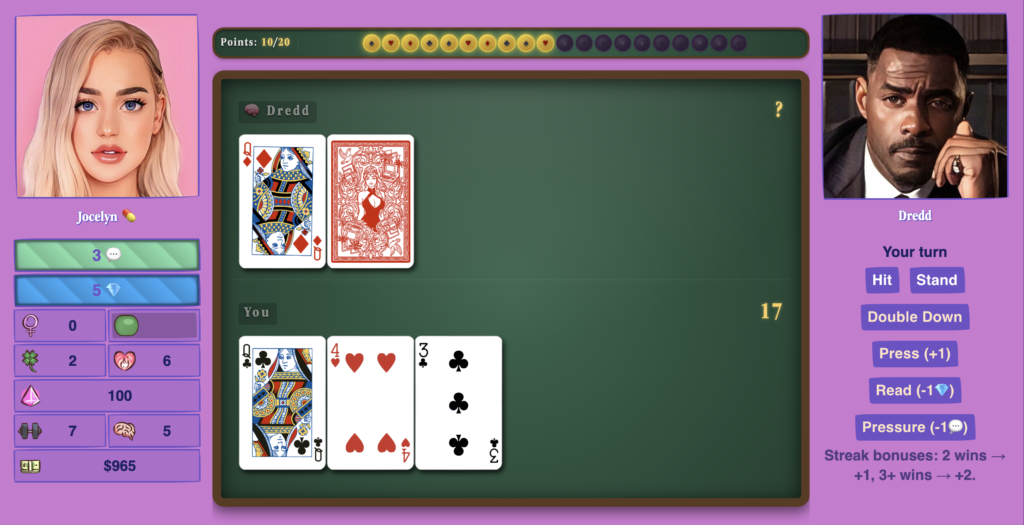
In Summer City, you’re not playing for chips. You’re playing for a points bar that fills to 20, and whoever gets there first wins. Drop to zero, you lose.
The cards work the same as regular blackjack—2-10 are face value, face cards are 10, Aces count as 1 or 11 (whichever helps). But the person across from you isn’t a casino dealer running on autopilot. They’re playing to beat you, and they have tells, habits, and personalities you can learn to read, depending on your character’s stats!
How Hands Score
Winning: A normal win nets you +3. Dealer busts, that’s +4. Hit 21 and you’re looking at +6, or +7 if the dealer also busts. If you land 21 against their 20, it’s +5.
Losing: Standard loss is -2. You bust, also -2. Dealer hits 21 on you, -4. Your 20 against their 21 softens to -3.
Push: Nothing moves. But here’s the thing—a push doesn’t break your streak.
Streaks
And on that note, streaks! Win streaks stack bonuses. Two wins in a row gives your next win +1. Three or more gives +2, and it keeps paying as long as you keep winning. This changes everything about how you play. When you’re on a streak, boring wins are secretly excellent. A push doesn’t move points, but it doesn’t break your streak either. Sometimes playing safe is the aggressive move.
And in Summer City blackjack, you have more options for how to play…
Your Moves
Hit and Stand work exactly how you’d expect. Hit when you’re low (anything 11 or under is almost always a hit). Stand when you’re strong (17+ usually). The gray zone from 12-16 is where the game actually happens.
Double Down locks you into exactly one more card, but doubles whatever you win or lose. Use it when you’re sitting on 9-11 and feeling good about pulling a face card. Don’t use it when you’re already in danger territory or barely ahead on points.
Press is a confidence button. Once per hand, you can press to add +1 to your win or -1 to your loss. It doesn’t change your cards, just the stakes. Press when you’re pretty sure you’ve got it. Don’t press when you’re on thin ice.
Surrender is only available on your opening hand, before you hit. You fold for a small loss (usually -1, sometimes -2), but here’s the key: surrender doesn’t reset your streak. It steps it down instead. When you’re protecting momentum or staring at a garbage hand against a strong upcard, surrender is damage control.
Insurance comes up when the dealer shows an Ace. Pay 2 points, and if they flip a natural blackjack, your loss becomes zero. If they don’t have it, you just burned 2 points for nothing. It’s a hedge, not a shield—if you would’ve pushed anyway, insurance costs you for no reason.
Resource Moves
These are “meta-moves”, referencing things your CHARACTER is doing, rather than specific Summer City Blackjack mechanics.
Read costs 1 Willpower and uses your Intellect. You get a hint about the dealer’s hidden strength and a rough estimate of their total. Use it when you’re genuinely stuck in the 15-17 danger zone, or when you’re about to commit to a Press or Double Down and want some confirmation. Don’t burn it on obvious hands.
Pressure costs 1 Wit and uses your Charm. If it lands, the dealer plays riskier on their turn—more likely to hit when they should stand, more likely to bust. Some dealers shrug it off. Others hate it. Bruce is easy to rattle cause he’s a hothead. Dredd basically isn’t.
Five-Card Charlie
If you reach five cards without busting, you earn a bonus—but only if you win the hand. Charlie isn’t an automatic win. It’s extra points on top of a win you would’ve gotten anyway.
Chase Charlie when you’ve got low totals across 3-4 cards and the path forward looks safe. Don’t chase it when you’re already sitting at 16 and one more card is basically a coin flip on busting.
The dealer can chase Charlie too. If they start stacking small cards, pay attention. Their Charlie makes your loss worse.
Reading the Dealer
The person dealing isn’t a machine. They project confidence, boredom, irritation—and those signals can mean something or nothing. Treat tells as soft information. They’re hints, not answers.
Bruce plays fast, performs, runs on swagger. He’s easier to rattle with Pressure but also easier to misread because he’s always putting on a show. Don’t let him bait you into ego plays.
Dredd is controlled, quiet, patient. Pressure barely touches him. If you give him a clean lane, he’ll take it. Save your resources for real turning points, not theatrics.
Everyone else falls somewhere in the middle—more readable over time, punishes sloppy aggression, rewards steady play.
Playing the Points Bar
Early game: Build a platform. Take normal wins, don’t Press every hand, save Read and Pressure for decisions that actually matter.
Mid game: This is where you choose your risks. If you’re behind, start looking at Double Downs on promising totals, Press when confident, chase 21 more aggressively. If you’re ahead, protect the bar—aim for safe stands, let the dealer take the risky lines.
Closing out: Ask yourself one question: do you need a big payout, or do you just need to not bleed? If +3 wins you the game, play for stability. If the dealer is near zero, don’t hand them a comeback.
When you’re near zero: Survival first. Surrender becomes extremely valuable. Avoid Press unless it’s a calculated last bullet. Use Read to stop yourself from throwing the match on a guess.